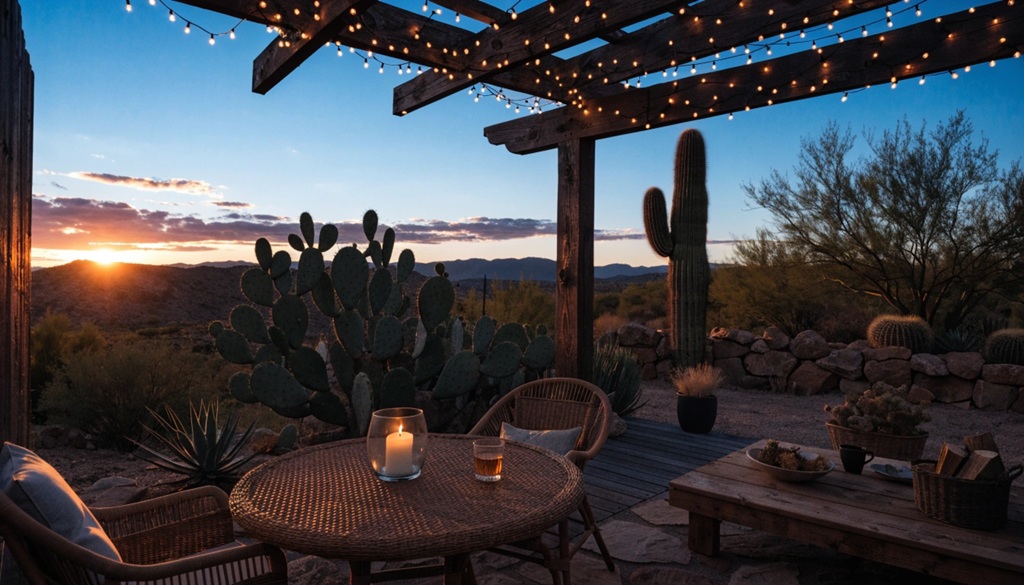
There’s nothing quite like a warm Arizona evening on the patio—until the sun dips below the mountains and you’re left in the dark or, worse, tangled in extension cords running across your walkway. Solar string lights seem like the obvious fix, but the Arizona climate throws some serious curveballs at outdoor lighting. The intense summer heat, the brutal UV exposure, and the dramatic temperature swings between day and night can destroy cheap lights in a single season. The good news? You can absolutely find durable, beautiful solar string lights for arizona patios if you know exactly what to look for. This guide breaks down the technical specs, the practical considerations, and the common mistakes so you can make a smart purchase that actually lasts.
Key Takeaways
- Battery capacity (mAh) matters more than the number of LEDs when it comes to runtime and brightness in Arizona’s sunny climate.
- You need a panel with a high conversion efficiency and ideally a separable panel design so you can position it in full sun while hanging lights in shaded areas.
- Look for an IP65 rating or higher to protect against dust and rain, but understand that UV degradation of plastic components is a separate issue to address.
- Heat is the number one killer of solar light batteries—lithium-based cells handle Arizona summers better than NiMH or NiCd.
- Choose warm white or adjustable color temperature lights to create the right ambiance; cool white can feel harsh for residential patios.
Why Most Solar String Lights Fail in Arizona
Arizona presents a specific set of challenges that simply don’t exist in milder climates. It’s not just about getting enough sun—that part is easy. The real issues are heat, UV radiation, and the way those two factors interact with the materials and electronics inside the lights.
When a set of solar lights fails after a few months in Phoenix or Tucson, it’s rarely because the panel didn’t get enough sunlight. More often, the battery has cooked, the plastic housing has become brittle and cracked from UV exposure, or the solder joints inside the controller have failed from repeated thermal expansion and contraction. Understanding these failure modes helps you shop for products designed to survive them.
Another overlooked issue is the monsoon season. While Arizona is dry overall, the summer monsoon brings sudden, intense dust storms followed by heavy rain. If your solar panel is mounted flat on a pergola, dust can accumulate and block sunlight. If it’s mounted at an angle, rain can help clean it but might expose connection points to moisture. The best products account for this; the cheapest ones don’t.
Battery Type and Capacity: The Heart of the System
Most solar string lights rely on rechargeable batteries—either AA or AAA cells in the light sockets themselves, or a hardwired battery pack inside the solar panel housing. In either case, the chemistry of the battery makes a huge difference in Arizona heat.
Older and cheaper lights often use NiMH (Nickel-Metal Hydride) or NiCd (Nickel-Cadmium) batteries. These degrade rapidly when exposed to high temperatures. A NiMH battery in a 110-degree day may lose 20% to 30% of its usable capacity within the first few months. NiCd batteries are even worse—they have a memory effect and struggle with high temperatures too.
You want lights that use Lithium-Ion or Lithium-FePO4 (Lithium Iron Phosphate) batteries. These chemistries handle heat far better, have a longer cycle life, and maintain more consistent voltage output until the battery is nearly depleted. Look for the battery type listed in the product specs or on the packaging. If the manufacturer doesn’t specify, that’s usually a red flag.
Capacity matters even more than chemistry. Battery capacity is measured in milliamp-hours (mAh). A set of 100 LED lights with a 600mAh battery will run for a couple of hours at full brightness before fading. A set with a 1200mAh battery might run for 6 to 8 hours. Obviously, the runtime you need depends on the season and how late you stay outside, but given that Arizona gets plenty of sun, there’s no excuse for buying lights with tiny batteries. Look for at least 1200mAh for basic string lights, and consider 2000mAh+ if you want options like dimming modes or longer runtimes.
How to Check the Battery Spec Without Opening the Product
Check the product listing description, the actual packaging, or look for a picture of the solar panel unit where the spec might be printed on a label. Amazon listings often show the spec in the product description but not in the bullet points. If it’s not listed anywhere, contact the manufacturer or choose a different product. The absence of a battery spec is a major warning sign that the manufacturer is cutting costs.
Solar Panel Size and Efficiency
The solar panel is the engine of your string light system. It converts sunlight into electricity to charge the battery. A bigger panel generally means faster charging and more energy, but panel technology matters too.
Monocrystalline panels are the most efficient. They convert a higher percentage of sunlight into electricity compared to polycrystalline or amorphous panels. In the blazing Arizona sun, efficiency might seem unnecessary—you have plenty of sunlight, right? But the issue is charging time and maintaining a charge over multiple cloudy days or during monsoon season. A monocrystalline panel can fully charge a battery in 4–6 hours of direct sun, whereas a cheaper polycrystalline panel might need 8 hours.
Panel wattage also matters. A 2W panel is significantly better than a 0.5W panel, regardless of the number of LEDs. Higher wattage panels charge the battery faster and can keep up with the power draw of a long string of lights.
The Advantage of Separable Solar Panels
Patio lighting naturally belongs in covered, shaded areas—beneath a pergola, under a ramada, or along a sheltered stucco wall—which creates a fundamental conflict for standard all-in-one solar string lights whose built-in panels require direct sunlight to function. Opting for a system with a separable solar panel solves this entirely; connected via an extended lead cable (typically 5 to 15 feet), the panel can be mounted in an unshaded spot on a roofline or pole while the lights comfortably illuminate your shaded lounge area. This structural flexibility becomes even more critical when managing intense desert heat, so as you design your outdoor layout to balance ambient lighting with active thermal management, explore brise soleil differs from solar shading to ensure your overall patio architecture maximizes both illumination and heat protection.
Brightness, Color, and Bulb Technology
Brightness is measured in lumens, and for string lights, the relevant spec is usually total lumens or lumens per bulb. For ambient patio lighting, you don’t need floodlight brightness. A string of 50 to 100 LED bulbs with a warm glow (around 2700K to 3000K color temperature) creates a welcoming atmosphere without feeling like a football stadium.
Color temperature matters more than people think. “Warm white” (2700K–3000K) is what you typically see in traditional incandescent patio lights. It makes the space feel cozy and flatters skin tones. “Cool white” (5000K+) is harsh, clinical, and feels like a security light rather than an entertaining space. Many premium lights now come with a remote control or an inline switch that lets you toggle between warm white, cool white, and red or green for holidays. If you want versatility, look for that feature.
The LED count matters less than the quality of the LEDs themselves. Cheap LEDs flicker visibly and have a short lifespan. Look for lights that mention “SMD” (Surface Mounted Diode) or high-quality LED chips. Also read reviews for flicker complaints—the human eye can detect subtle flicker, which causes headaches and makes the lights look cheap.
Durability in Heat and UV: Materials Matter
Using an IP-rated product is essential, but it’s not the only durability metric that matters in Arizona. IP ratings (Ingress Protection) tell you how well a device resists dust and water. For outdoor string lights, you want a minimum of IP65—that means fully dust-tight and protected against water jets (like from a hose). IP67 is even better—it means the device can be temporarily submerged in water. Given monsoon storms and the occasional pressure washing, IP67 is worth paying for.
But IP ratings don’t tell you anything about UV resistance. The intense Arizona sun degrades plastic even if it’s perfectly sealed. The plastic lens caps on LED bulbs, the wire insulation, and the solar panel casing all experience UV damage. When plastic degrades, it becomes brittle, discolored, and cracks. Even the wires themselves can become stiff and crack if they aren’t made of UV-stabilized PVC or rubber.
Some brands explicitly list “UV-resistant” or “UV-stabilized” in their descriptions. If the product doesn’t mention it, check for wire insulation that feels thick and flexible rather than thin and brittle. Read reviews from customers in Arizona, Texas, or other hot climates. Those reviewers will tell you whether the lights survived a summer or had to be replaced by September.
Choosing the Right Bulb Shape and Style
You might not think bulb shape matters for solar lights, but it does for two reasons: light diffusion and wind resistance. The classic “S14” bullet-shaped bulbs or vintage Edison-style bulbs with a clear lens create a beautiful glow. However, the larger the bulb housing, the more surface area for wind to catch. Arizona doesn’t have constant strong winds, but monsoon storms bring sudden gusts that can knock poorly-hung lights around or strain the string.
Smaller, shatterproof LED bulbs are more aerodynamic and add less weight to the string line. If you are hanging lights over a long span, like the perimeter of a ramada, you want to keep the total weight low so the line doesn’t sag excessively. Weigh this consideration against your aesthetic preferences. If you want the big Edison bulbs, you might need to install a stronger support cable to carry the load.
Installation and Placement Best Practices
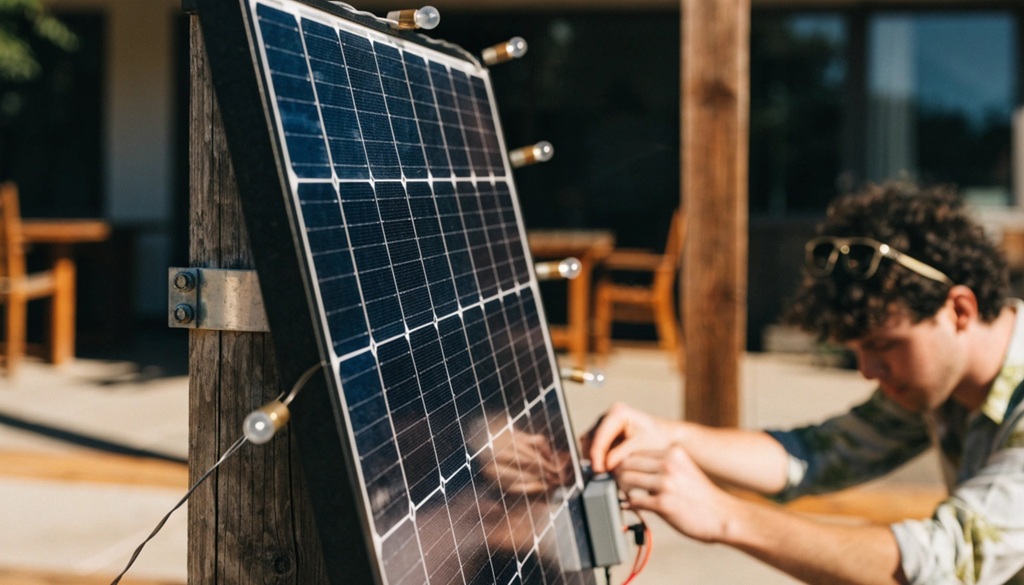
Getting the installation right is just as important as choosing the right product.
- Mount the panel south-facing or west-facing. In Arizona, a direct south-facing panel gets the most sun. A west-facing panel works well for patios used in the evening because it captures sunlight later in the day, giving you more runtime at night.
- Angle the panel at about 30 to 45 degrees. Flat panels accumulate dust and can be less efficient. An angled panel self-cleans during rainstorms and captures more direct sunlight throughout the day.
- Keep the panel clear of debris. During cottonwood season or across the summer, dust and cottonwood seeds can blanket the panel. A quick wipe with a damp cloth every couple of weeks makes a noticeable difference in nighttime brightness.
- Position lights so they don’t bake unnecessarily. While the bulbs themselves are LEDs (which generate little heat), the wires and housings still suffer from prolonged exposure. If you have the option, hang lights under a covered patio rather than in full direct sun. The shade isn’t just for your guests—it’s for the light fixtures themselves.
- Use a dedicated support line. Most solar string lights have a thin wire that is not designed to be pulled taut. String a separate wire or cable (like a stainless steel cable) between anchor points and then drape your string lights over it or zip-tie them to it. This reduces tension on the lights’ wiring and prevents breakage during windy storms.
The Real Cost Equation: Upfront Price vs. Lifespan
It’s tempting to grab a $15 set of solar lights from a big-box store. But when you do the math on lifespan, that cheap set is the most expensive option.
A typical cheap set (under $20) uses NiCd or generic lithium batteries, a low-efficiency panel, and thin plastic components. In an Arizona climate, expect these to fail within 6 to 12 months. You’ll buy a replacement set, and within two years, you’ve spent $40 to $60.
A higher-quality set (between $30 and $80) with a lithium battery, a monocrystalline panel, and a proper IP65 rating can last 3 to 5 years. Even at $80, that’s $16 to $27 per year, which is less than the cheap-set annual cost. And you don’t have the hassle of re-installing lights every season.
Look at the warranty as well. A manufacturer that offers a 1-year or 2-year warranty is signaling confidence in their product’s durability. A product with no warranty is a gamble that the manufacturer doesn’t want to back.
Smart Features Worth Considering (and Some to Skip)
Modern solar string lights come with an array of features that range from genuinely useful to forgettable.
- Remote controls: Useful if the lights are mounted high up and you don’t want to reach a manual switch. Look for a remote that works up to 3 meters (about a foot). Remember that the sensor on the solar panel is your primary reset—if the lights are misbehaving, covering the panel with your hand for a few seconds to simulate darkness can often wake them up.
- Dusk-to-dawn sensors: This is the default behavior for most solar lights—they turn on automatically when light levels drop and stay on until the battery drains or dawn breaks. Make sure the sensor is on the solar panel, not on the light string itself—otherwise, if you have the string under a bright porch light, it might never turn on.
- Timer functions: Some controllers let you set the lights to run for 4, 6, or 8 hours. This is great if you want the lights to shut off automatically to conserve battery, but you may find the manual switch on the panel sufficient.
- App connectivity and smart-home integration (Alexa, Google Home): This is neat but rarely necessary for string lights. It adds cost and complexity, and the apps are often clunky. Smart features also consume a bit of standby power. Unless you are building out a whole home automation system where the patio lights need to match your “movie night” scene, skip these.
Common Mistakes to Avoid When Buying
Many posts highlight what to buy, but equally valuable is knowing what mistakes to steer clear of. These are the most frequent purchase errors people make with solar string lights in the desert.
- Focusing only on the number of LEDs: A string that boasts “100 LEDs” might still be dim if the battery is tiny and the panel is small. You have to look at the total energy package.
- Ignoring the “Solar” panel placement during installation: This is the most common reason people think solar lights are useless. They hang the entire string, including the panel, in the shade and then complain the lights don’t work.
- Not reading warranty details: The warranty often requires you to keep the receipt and have the original packaging to file a claim. If you are buying around November for December holiday lighting, keep the packaging safe until you know the lights work in the long run.
- Confusing “Battery Included” with “Quality Battery”: The fact that a battery is included doesn’t guarantee its capacity or chemistry. Always look for the specific mAh and chemistry type (lithium preferred).
- Assuming all “warm” lights are equal: As discussed, color temperature is measured in Kelvins. Bulbs at 2700K are softer and warmer than those at 4000K. If the product description says “warm white” but doesn’t give a Kelvin rating, be cautious—it could be anything.
Frequently Asked Questions
How long do solar string lights last in Arizona’s heat?
With proper care and a quality build, you can expect between 2 to 4 years. The batteries will degrade over time regardless, but the electronics and plastic housings should survive if the product uses UV-stabilized materials and a lithium-based battery.
Can solar string lights be left out in the rain and monsoon winds?
Yes, if they have a minimum IP65 rating and are installed securely. You should bring them down during severe storms if they hang from a large span with no support, but a standard installation on a pergola or patio cover should handle monsoon weather without issue.
Do solar string lights work in the winter in Arizona?
Absolutely. Arizona winters are mild, and you get plenty of direct sunlight. You might get slightly shorter runtimes if you have a series of cloudy days, but in general, the winter sun is more than sufficient to charge the batteries.
What does “automatic on/off” mean for solar lights?
It means the lights use a photocell (a light sensor) to detect when the ambient light level drops below a certain threshold at dusk. The lights turn on automatically and remain on until they either sense daylight again or the battery is exhausted.
Is it better to buy more expensive solar string lights?
Not always, but price is a strong indicator of quality. The critical components—the battery chemistry, the solar panel type, and the IP rating—cost more money to manufacture. A moderately priced set (over $30) with a decent battery and panel will outperform a $15 set on day one and last much longer.
How can I extend the lifespan of my solar string lights?
Clean the solar panel regularly to ensure maximum charging efficiency, store them indoors during the most extreme summer months if they are removable, and bring them inside during any windstorm that could cause physical damage. Also, adjust the panel angle seasonally if you can—steeper in winter, flatter in summer.
Conclusion
Selecting the right solar string lights for your Arizona patio isn’t about luck—it’s about checking the right specs. Don’t get distracted by the number of LEDs or glow modes. Focus on the battery chemistry and capacity, the solar panel type and wattage, and the durability ratings for dust/water (IP). Prioritize lights with a separable panel so you can position the panel in the sun while hanging the lights in the shade—that’s the single most important installation decision you’ll make. Look for UV-stabilized plastic and lithium batteries that can handle the heat. The initial cost might be a little higher than the bargain-bin options, but the extra durability translates into years of evening comfort under the stars, without the annual hassle of climbing a ladder to replace a string of dead lights.