

Your business has likely outgrown spreadsheets when manual work, data errors, and reporting delays become daily problems. An Enterprise Resource Planning (ERP) system becomes the better solution because it centralizes data, automates workflows, and gives every department access to accurate information.
Many businesses still begin with spreadsheets because they are affordable and familiar. However, studies show that more than half of businesses now use specialized business software, while ERP adoption rises sharply as companies grow. Spreadsheet users also report frequent manual updates and hidden errors that slow operations. These trends highlight a clear shift toward integrated systems as organizations expand.
Why Spreadsheets Eventually Reach Their Limits
Spreadsheets remain excellent tools for calculations, budgeting, and small data sets. They help startups organize information without significant costs.
Growth changes everything because more employees, customers, and transactions increase operational complexity. Consequently, spreadsheets become harder to maintain while mistakes become more expensive.
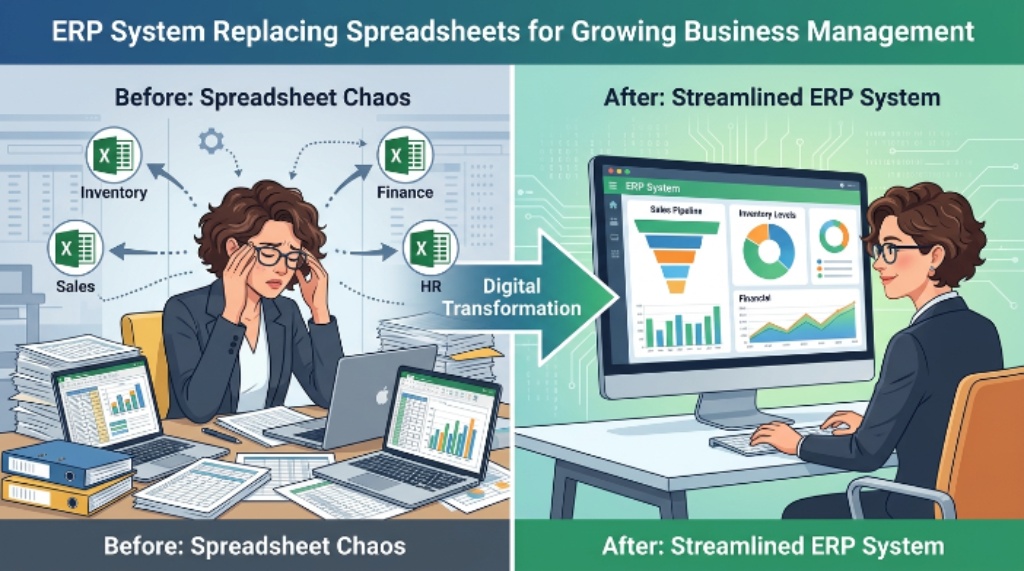
ERP software connects departments through one shared platform. Every authorized employee works with the same live information instead of separate files.
Top Signs Your Business Has Outgrown Spreadsheets
Multiple Versions Create Confusion
Different employees often save separate spreadsheet copies. Nobody knows which file contains the latest information.
Eventually, conflicting numbers create reporting mistakes. Therefore, managers spend valuable time verifying basic business data instead of making decisions.
Manual Data Entry Consumes Too Much Time
Employees repeatedly copy information between sales, accounting, inventory, and purchasing sheets. This repetitive work increases labor costs.
Moreover, every manual entry creates another opportunity for human error. Automation removes much of this unnecessary workload.
Reports Take Too Long
Monthly reporting should support quick decisions. Instead, your team spends several days gathering numbers from different files.
Business leaders need current information instead of outdated reports. ERP dashboards generate real time insights without lengthy preparation.
Frequent Formula Errors
Complex spreadsheets often depend on hundreds of linked formulas. One accidental change can affect every report.
Even experienced spreadsheet users occasionally create calculation mistakes. Built in ERP validation helps reduce these costly errors.
Inventory Problems Increase
Inventory records become unreliable when multiple employees update different spreadsheets. Stock shortages and overstock situations become common.
Accurate inventory visibility improves purchasing decisions. Customers also receive more reliable delivery information.
Departments Work Separately
Sales, finance, operations, and purchasing often maintain independent spreadsheets. Information remains trapped inside separate departments.
ERP creates one shared database. Every department accesses consistent information while maintaining appropriate security permissions.
Customer Service Suffers
Customer representatives cannot answer simple questions without contacting other departments. Delays reduce customer satisfaction.
Integrated systems provide quick access to order history, inventory levels, invoices, and shipping updates. Faster responses improve customer experiences.
Business Growth Feels Difficult
Adding employees often creates additional spreadsheet files instead of better processes. Operations become more complicated every month.
Growth should increase efficiency rather than confusion. ERP provides structured workflows that support expansion.
Compliance Becomes Harder
Businesses must often maintain accurate financial records and operational documentation. Spreadsheet changes may leave limited tracking information.
ERP systems maintain activity records and approval histories. Better documentation supports internal controls and audits.
Decision Making Depends on Guesswork
Managers should rely on accurate business intelligence instead of assumptions. Unfortunately, outdated spreadsheets rarely provide complete visibility.
Real time dashboards help leaders recognize trends quickly. Better information supports better business decisions.
Common Problems Businesses Experience
Growing companies often recognize several warning signs before considering ERP implementation.
- Employees spend hours updating spreadsheets every week.
- Reports contain inconsistent numbers.
- Inventory accuracy continues declining.
- Customer orders experience unnecessary delays.
- Financial closing takes longer every month.
- Different departments disagree about business data.
- Important files become difficult to locate.
- Manual processes slow daily operations.
Businesses experiencing several of these issues should evaluate integrated business software.
How ERP Solves These Challenges
Centralized Business Data
ERP stores important information inside one secure database. Everyone works from the same trusted source.
This approach eliminates duplicate files while improving consistency across departments.
Workflow Automation
Routine tasks no longer require repetitive manual updates. Automated workflows reduce processing time while improving accuracy.
Employees spend more time solving business problems instead of copying information.
Better Collaboration
Departments share information without sending endless spreadsheet attachments. Communication becomes faster and more reliable.
Collaboration improves because everyone views current business information immediately.
Real Time Reporting
Executives no longer wait until month end for performance updates. Dashboards display current sales, inventory, purchasing, and financial information.
Quick visibility helps businesses respond faster to market changes.
Stronger Security
Spreadsheet files often circulate through emails and shared folders. Sensitive information becomes difficult to protect.
ERP systems provide user permissions and controlled access. Businesses protect confidential information more effectively.
Which Businesses Benefit Most From ERP?
ERP benefits organizations experiencing operational complexity rather than focusing only on company size.
Industries commonly adopting ERP include:
- Manufacturing
- Wholesale distribution
- Retail
- Construction
- Professional services
- Healthcare
- Food production
- Logistics
Growing companies within these industries often gain significant operational improvements after replacing spreadsheet based processes.
When Should You Move Beyond Spreadsheets?
Businesses should consider ERP before operational problems become severe. Waiting too long increases migration complexity.
A good time to evaluate ERP includes situations where manual work increases faster than revenue. Early planning creates smoother implementation while minimizing disruption.
Tips Before Choosing an ERP System
Selecting software requires careful planning rather than rushing into implementation.
- Document current business processes.
- Identify repetitive manual tasks.
- Define measurable business goals.
- Include department leaders during planning.
- Prioritize integration requirements.
- Plan employee training early.
- Choose scalable software supporting future growth.
Careful preparation improves implementation success while increasing employee adoption.
Mistakes to Avoid During ERP Adoption
Many businesses focus only on software features instead of operational improvements. Successful implementation requires broader planning.
Avoid these common mistakes:
- Ignoring employee training.
- Migrating inaccurate spreadsheet data.
- Customizing everything immediately.
- Setting unrealistic timelines.
- Excluding department managers from planning.
- Measuring only software costs instead of long term value.
Strong preparation reduces implementation risks while increasing return on investment.
Conclusion
Spreadsheets remain valuable tools for small operations, yet they eventually create limitations as businesses expand. Manual work, reporting delays, inventory errors, and disconnected departments clearly indicate the need for ERP. Evaluate your current processes honestly, identify recurring bottlenecks, and begin planning an ERP strategy before growth becomes harder to manage.
FAQs
What is the biggest sign a business needs ERP?
Frequent manual work and inconsistent business data are usually the strongest warning signs.
Can small businesses benefit from ERP?
Yes, growing small businesses often improve efficiency through modern cloud based ERP systems.
Are spreadsheets completely unnecessary after ERP?
No, spreadsheets still support analysis and temporary calculations alongside ERP systems.
How does ERP improve reporting?
ERP automatically combines business data into real time dashboards and standardized reports.
Should every growing company replace spreadsheets?
No, businesses should adopt ERP only when spreadsheet limitations begin affecting productivity, accuracy, or growth.


